Wednesday, January 19, 2011

The Cowboy Code

Here is the Cowboy Code, as laid down by "Cowboy No. 1", Gene Autry.

1.
The Cowboy must never shoot first, hit a smaller man, or take unfair advantage.

2.
He must never go back on his word, or a trust confided in him.

3.
He must always tell the truth.

4.
He must be gentle with children, the elderly, and animals.

5.
He must not advocate or possess racially or religiously intolerant ideas.

6.
He must help people in distress.

7.
He must be a good worker.

8.
He must keep himself clean in thought, speech, action, and personal habits.

9.
He must respect women, parents, and his nation's laws.

10.
The Cowboy is a patriot.

Friday, January 7, 2011

T + 50: Whence the Vision and the Dream?

Left: An abandoned launch pad at Cape Canaveral.

A number of years ago I had what seemed at the time a rather strange and unbelievable idea for a story. It took place sometime in the future, and involved a couple of children who were fascinated by space travel--which to them was entirely a thing of the past, a sort of romantic historical curiosity, the way 20th century children viewed pirates or cowboys-and-Indians. Rather than futuristic, rockets and space for these children were quaint symbols of bygone days.

Today, with the looming retirement of the space shuttle, the cancellation of the Constellation program (and therefore no clear successor to the shuttle), and a general lack of public interest in and political support for space exploration (which has been the case since the moon landing some 40 years ago), that story premise no longer seems so far-fetched.

Back in the 50s and 60s, space exploration seemed like the obvious next step in human history. This was especially true for many in the U.S., a country which, as one of the world's two great superpowers, saw itself as leading the way for the rest of the world (at least the "free world"). All the frontiers of the United States had been explored and settled; a prosperous and (more or less) peaceful postwar American society, with ever-advancing technology and science, was poised to begin humanity's next great adventure: exploring outer space, which of course is simply to say the universe beyond our small planet ("this island earth", as the title of one 50s sci-fi film described it).

To understand what happened to the dream of spaceflight, it might be worth asking why we had the dream in the first place. Where did this idea--the idea that space exploration was the inevitable next phase of human history--come from? Or, to put it another way, how did space travel move from the realm of children's fantasy (a la Buck Rogers) to a realistic, serious expectation for the near future?

Some say it all started with the publication in 1949 of a book called The Conquest of Space. With its magical paintings by Chesley Bonestell, this hugely influential book sparked the imaginations of many children and adults and made space travel suddenly seem like a real possibility in one's own lifetime.

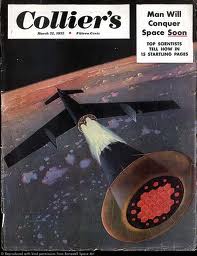
Then, in the early 1950s, Collier's magazine published a series of articles, again with many wondrous illustrations by Bonestell, elaborating how "Man Will Conquer Space Soon".

Both this book and these articles were written, and the ideas within them dreamed up, by what we might describe as a bunch of "space nerds". Foremost among them was the famed German rocket scientist Werner von Braun, who was instrumental in helping to develop modern rocketry.

But why did the ideas of a few brainy rocket scientists and space nerds, who had been laboring for decades in obscurity as members of "rocket" or "interplanetary" societies, so capture the popular imagination in the years after World War II? What exactly was it that so captivated our imaginations and excited us about leaving the safe, familiar confines of the world we had always known and venturing out into the great black infinite abyss?

Some would say that, despite all the practical justifications for space travel (whether economic, political, military, scientific, or technological), the essential reason we want to "go there", the truest and deepest reason, the real reason that we are too pragmatic and prosaic to admit... is simply because human beings have an innate urge to explore.

In this view, space exploration needs no justification outside itself... it is indeed obvious. Of course we have a drive to explore. Exploration and expansion to new territories, be they literal or figurative, are an essential and inescapable part of human history. It is part and parcel of human nature to be curious about what is "out there", beyond what we know, and to seek to discover for ourselves some part of reality as yet unknown to us.

But just because the exploration of the "final frontier" might be obvious as a desire or a goal does not mean that it is inevitable as an actual action or event. When one loses inspiration, motivation, and vision, one is not likely to achieve a long-held dream. The dream will not automatically turn itself into reality... but the dream must first exist before it can come true.

Tuesday, January 4, 2011

T + 50: 50 Years of Man in Space

The year 2011 marks two important anniversaries in the history of human spaceflight:

  • 30 years since the start of the space shuttle program, which is due to come to an end this year.
  • 50 years since the start of human spaceflight, when Soviet cosmonaut Yuri Gagarin (pictured) became the first man in space.
And of course, it is now a full decade on since the once-fabled year 2001, made mythic by Stanley Kubrick's masterful film of the same name (see my earlier post about that film).

Here's today's $64,000 question: Should 2001: A Space Odyssey be reclassified as historical fiction?

In this new occasional series, T + 50, I aim to explore the significance of human spaceflight, yesterday, today, and tomorrow. What used to be seen as the crowning pinnacle of modern civilization and the very symbol of humanity's future had become passe long before we arrived in the 21st century. Were we all just deluded by science fiction fantasies back in the 1950s and 60s? Or did we lose a grand and optimistic vision of expansion beyond the earth? Why should we care about exploring space anyway?

As a lifelong space fan, these are questions that have haunted me for most of my adult life and that I wish to investigate further in the present series. Whatever your level of interest in outer space and its exploration, I hope you enjoy taking this thought journey with me.

As the Amazing Criswell once said, "We are all interested in the future, for that is where you and I are going to spend the rest of our lives. And remember my friend, future events such as these will affect you in the future."

T minus 3... 2... 1...

Friday, December 17, 2010

Thoughts on Becoming a Parent

This week I suddenly found myself the father to a beautiful and wonderful baby girl. Even though her arrival was not exactly a surprise, in a sense it was the greatest surprise of my life. The moment she came kicking and screaming into the world, announcing her arrival loud and clear with her brand new (and already powerful) set of lungs, my wife and I looked at each other with what seemed a mixture of relief, joy, and utter amazement. What had been for 9 months a more or less abstract idea had suddenly appeared in the flesh, a living, breathing human being that we were responsible for bringing into the world. How could such things be?

When I was a younger man I felt ambivalent about the idea of having children. I think this was partly explainable by the feeling--not that I thought of it this way at the time--that my own life was a story whose outline and plot I was still trying to figure out, and that therefore I wasn't ready to launch a whole new story for someone else. In other words, why give impetus to a new human life when I was still working out the purpose and meaning of my own existence?

But now I can see that such hangups are completely beside the point. If a human life is a story--and I believe that a life is the very model of a story, the thing that stories imitate--then none of those stories are complete, or even remotely figured out, until you reach the end. Which means, of course, when you die. Every person who becomes a parent does so in the middle of things (in medias res, as in the ancient epics), while busily trying to sort out their own lives. In fact, the very act of parenthood, for those who choose it, is a monumentally important aspect of their own lives, and is one of the main factors that helps to make their lives--and their selves--what and who they are.

As a non-parent, I often heard it said that parenthood changes you, that it is impossible to comprehend the love a mother and father feel for their child without having experienced it yourself. As a new parent, I now know this from experience. Looking back, I feel that my love for my daughter grew in parallel with her growth in my wife's womb, starting as just a mustard seed upon news of her coming. Seeing the ultrasound image and learning that our child was a girl made her--and our love--one degree more real. Giving her a name made her even more real, an identifiable and unique human being. Yet she remained an enigma, an invisible and still ultimately abstract idea.

My daughter was born five days after her predicted due date, and in the final days before her birth I felt a bittersweet longing, an anxious eagerness to meet her. Upon finally--yet so suddenly--seeing her live and in person, our love for her also emerged, fully formed, as sudden and surprising as she herself.

How can I describe the love of a parent for his or her child? Like any love, it will have its ups and downs, its waves and troughs. But, as with any love, these fluctuations are only on the surface of a vast underlying sea. It has started out for me, as it undoubtedly does for most new parents, on a crest of euphoria. Strange as it may sound, the closest thing I can compare it to is the experience of being in love. Actually, it truly is being in love, just a different kind of love than is usually meant by that expression. Everything seems more meaningful, more valuable than it did before. The world glows in a radiant light that somehow had not been quite so visible until now. My daughter is to me the rarest and most precious of all earthly treasures, even though I hardly know her--even though it may seem to an outside observer that there is hardly anyone there to know. But to me she is (alongside my wife) the most interesting and important person in the world.

Where does this deep, vast sea of love come from? It is as mysterious as life itself. In fact, I would say that love, in its wide variety of forms, is the very meaning of life itself. This conviction I actually arrived at some 20 years ago, when, as a budding philosopher, I wondered what the ultimate meaning and purpose of existence was. Following the trail as far as I could, I could not get past one idea: love. This may sound strange to those of a philosophical or, certainly, a scientific cast of mind. To understand intellectually what love is--to explain it or define it--is pretty much beyond human capability. But to my mind, love, understood in the broadest possible context, was what gave ultimate meaning to everything. When you think about it, everything else we consider important--money, power, fame, success--are ultimately meaningless and empty without love. The Apostle Paul was right when he said that without love, "I am nothing." Having reached this point, I realized that love could not be justified or explained in terms of anything else. It was its own marvelous and miraculous answer: this, I decided, must be what it's all about.

My daughter, new as she is to life, has confirmed this for me like never before. What is important has its importance only in relation to what the modern philosophers call subjective consciousness and what the ancient ones called the soul. To give a definition that does not really define much of anything, one might say that love is the valuation of one consciousness or soul for another as an end in itself, rather than a means to a further end. I want to give my daughter everything that is good, whether she ever returns the favor or not. I have no doubt that as she grows up and matures, she will bring me much pride and joy and returned love, but those are not the reasons I wish to give to her. She is an end in herself--her good, her benefit, is where the buck stops. Everything I do in relation to her is ultimately measured in those terms.

Yes, I am still in the process of writing my own life story, its direction clearer than it was before, yet still a work in progress. And now I have participated in giving life to a whole new person with a whole new story. This is the way of all flesh. Plants, animals, and human beings all give rise to further generations--this thing called reproduction is nothing more nor less than life affirming itself as good. Life, too, is a mystery. Scientists can explain the physical processes of life but no one can really explain what life is. But somehow we know that, like love, life is its own answer. As someone somewhere once said, "That is all ye know, and all ye need to know."

I look forward to teaching my daughter many great and wonderful things about life and the world we live in and about herself. But I look forward even more to all the great and wonderful things that she will teach me about life and the world we live in and about myself--things that, in her own remarkable way, she has already begun to teach.


Friday, November 12, 2010

The Tao That Can Be Effed Is Not The Eternal Tao

In "Effing the Ineffable", philosopher Roger Scruton discusses the undiscussable... that which is undiscussable not because of any distasteful content, but because it lies beyond the power of human language to express. Philosophers throughout the ages have, in the course of their philosophical journeys, come face to face with the ultimate, ineffable mystery of being, and have (in some cases at least) humbly given up the attempt to describe or explain it (while others, as Scruton playfully points out, have exhausted countless words in attempting to describe the indescribable).

Perhaps the most famous example of this reticence in the face of reality's ultimate mystery is the opening line of the Tao Te Ching (a favorite of my philosopher father): "The Way [Tao] that may be spoken of is not the eternal Way."

Scruton uses other examples, such as that of Thomas Aquinas, the builder of an immense, cathedral-like system of Christian philosophy in the 1200s, who ended up on his deathbed "in a state of ecstasy, declaring that all that he had written was of no significance beside the beatific vision that he had been granted, and in the face of which words fail."

There is also the modern example of Wittgenstein, who stated simply, "“that whereof we cannot speak we must consign to silence.”

As Scruton says, "There is nothing wrong with referring ... to the ineffable. The mistake is to describe it." The ineffable is that which is meaningful, but in a way that cannot be adequately expressed or captured in words. Often it is perceived in quasi-mystical experiences in which we might glimpse some deeper or fuller vision of the world, or perhaps an "intimation" (in Wordsworth's language) of another world beyond this one. Poetry is the closest that language can come to expressing such meanings, since poetry by its nature transcends the ordinary, practical use of language in order to express, or at least to suggest, the inexpressible.

Scruton gets high marks in my book for saying this about people who dismiss such notions of a transcendent reality as "unscientific fiction": "... people of this scientistic cast of mind are disagreeable to me. Their nerdish conviction that facts alone can signify, and that the “transcendental” and the eternal are nothing but words, mark them out as incomplete."

Wow.

Monday, October 18, 2010

My Lovely Frankenstein, Part 9

During the last week of school before Christmas, Boris was arrested after a gang fight and thrown in the town jail. Dr. Laren had to bail him out.

"Oh, Boris, what am I to do with you? Perhaps I should withdraw you from that school. Maybe it was a mistake to think that society could accept you."

Boris looked down sadly. "Dr. Laren... why... did you... make me?"

"I made you, dear Boris, to be the son I never had. You were so wonderful at first. But now you're breaking my heart."

Boris couldn't help but cry this time. "I'm... sorry... Dr. Laren. I just... want people... to like me."

"I know, Boris, I know. I'll tell you what. You don't have to go to Elmville High any more. From now on, you can stay here and I can teach you, and you can have your friends in the woods."

"Okay," said Boris, sniffing.

****

Boris tapped at Judy's bedroom window. She opened it.

"Boris, what are you doing here? You know I can't see you anymore."

"But Judy... I am going... to be good... again. No more... fights."

"Oh, Boris, have you really come back to your senses?"

"Yes. Dr. Laren... is taking me... out of school."

"Out of school? Well... I suppose that's what's best." She sighed and put her hand on his green cheek. "Are you going to be my old, sweet, gentle Boris again?"

"Yes."

"Well... all right, I suppose I'll give you another chance. But Dr. Laren might need to do some talking to my parents to convince them that you really are reformed."

****

Dr. Laren did talk to Mr. and Mrs. Parker, and explained how Boris had reverted to his former gentle self after withdrawing from school. They agreed to allow Judy to see him again.

Judy helped Dr. Laren and Boris decorate for Christmas. They listened to Bing Crosby records, baked cookies, strung lights, and hung ornaments. Boris's favorite part was putting the tinsel on the tree. And, of course, he placed the star on top.

Judy sat on the sofa beside Boris and lay her head on his large square shoulder. She closed her eyes and sighed with contentment. "Oh Boris," she said, "it's so nice to have you back."

"It's nice... to have you back... too," said Boris.

"No boy could be more beautiful than you, Boris Laren... my lovely Frankenstein."


THE END

Friday, October 15, 2010

My Lovely Frankenstein, Part 8

The next morning Boris walked down to Judy's house and rang the doorbell. Mr. Parker answered. "Well, hey there, Boris. Did you come to see Judy?"

"Does Judy... hate me?"

"Of course not, Boris. Why would Judy hate you?"

"She missed... the game."

"Oh, that. She stayed home because she wasn't feeling well. Would you like to see her?"

Boris's spirits lightened. "Yes.. want to see... Judy."

He lumbered down the hall to Judy's bedroom. She was still in bed but sitting up reading. Her face lit up when she saw him. "Boris, darling! I'm so happy to see you!"

"I'm... happy... too."

They embraced. Judy said, "I'm so sorry I missed your game last night. I caught cold. I'm still not feeling well. Father told me the bad news about the game. I'm sorry, Boris. Achoo!"

"Bless... you."

"Thanks."

"You... still love me?"

"Of course I still love you, Boris dear, don't be silly."

"Chip... told me... you... did not love me."

"Chip told you what? Why, that hooligan! You shouldn't listen to him, Boris. You know he's just jealous. You don't need to doubt my love for you."

"I know," said Boris with a shrug. "I was... afraid."

"Oh, Boris," said Judy, putting her arms about him, "I'll always love you, my big, green, adorable creature."

****

The other kids, however, had stopped loving Boris. Now, instead of admiring looks or friendly greetings, the other students gave him cold stares or just ignored him altogether. They also called him names and teased him. Frustrated, Boris started wearing jeans, T-shirts, and a leather jacket, put grease in his hair, smoked cigarettes, and got involved in gang fights. He even formed his own gang called The Creeps. Judy was worried.

"Boris, what has gotten into you? You used to be such a nice boy. But now..."

But Boris didn't care. Eventually Judy's parents forbade her to see him.

"And you know what the worst part is, Boris?" said Judy, tearfully. "They don't even need to forbid me, because... well, I don't want to see you anymore, now that you've become a hoodlum!"

This only increased Boris's anger and bad behavior. He was called to Mrs. Allen's office several times.

"Boris, I am very disappointed in you. For most of the semester you have been one of Elmville High's best students and star athletes, and now you have become a juvenile delinquent. If you don't shape up, I shall have no choice but to expel you."

And Dr. Laren said, "Boris, I'm very concerned about you. When I made you, I thought you were the most gentle creature on earth. Now you have become violent and increasingly savage. I did not make you a monster, Boris, but you are becoming one!"