Tuesday, April 12, 2011

T + 50: At Home in the Universe


Today, April 12, marks the 50th anniversary of the flight of Vostok 1, which made Soviet cosmonaut Yuri Gagarin the first human being in space. For half a century now, Homo sapiens has been a spacefaring species, the first earthly creature to venture beyond the atmosphere of this planet into what we call "outer space", which is of course almost the whole of physical reality. It would be more accurate, in fact, to say that we have always been in space, and that Yuri was the first human to leap off the tiny dust particle that we perceive as "the world" and to float apart from it for a spectacular, brief moment, alone in the inconceivably immense, dark sea of which our world is but an infinitesimally small part.

In those days, space flight was imbued with the aura of wonder, the way the world is when we are young children. It was perhaps inevitable that the glow would fade with time. Yet the disappearance of magic from the world, which we perceive as the product of maturing vision, like eyes adjusting to the bright light of day, is only an illusion. Adulthood does bring certain types of clarity, the corrective lenses of age that help us outgrow simplistic or simply false ideas. But age also brings blindness, and one does not need to be very old at all to have become blinded to the wonder and the beauty, the mystery and the majesty of the world we live in. It is still there, just as surely as it was when we were very young; it is we who have changed and become unable to see its luster.

Such has been the fate of space travel. Our space probes have beamed back a multitude of workmanlike photos of planets and moons, revealing these once-mysterious worlds to be as exotic and interesting as vacant lots. But this too is an illusion. It is like looking up one's childhood home and yard on Google Maps and seeing it revealed as the most plain, ordinary, and unremarkable place on earth, worlds removed from the happy, magical kingdom that you know it was.

The question is: which contains more truth and reality? The objective facts provided by the cold, detached view of science (or Google), or the subjective thoughts and feelings that make up our human response to reality? The mere facts about the world, like the dry recitations of an accountant, or the rich, meaningful experiences we have of the world, the stuff that makes up memories and dreams?

Outer space is still there, above our heads, its unfathomable depths miraculously visible to us on clear nights, when we can simply look up and with our own eyes behold stars that we could never reach even if we traveled at the speed of light for a thousand years. The amazing thing is not so much that we can now, by the aid of our advanced technology, travel upward in a feeble attempt to reach those stars, as the fact that we are already there. For, of course, we are already, and always have been, in the universe. The exciting thing about space travel is not that we are venturing "into" space, as though we had previously been outside of it, but simply that we are exploring it, finally beginning to experience more than just one tiny little speck floating in the vast ocean.

It is the objective, scientific view that sees the truth that our globe is a vanishingly small part of everything that is. But the childlike vision that takes in more of reality than the sober "realism" of adulthood knows a deeper truth: that significance has nothing to do with size, and that the earth we live on is incredibly interesting and important. The immensity of space does not diminish its stature, but only makes us realize that beyond the wide earth, the world we call home is a far bigger and more wondrous place than we could ever imagine.

Tuesday, March 8, 2011

The Enlightenment Was Wrong

In his op-ed column "The New Humanism", David Brooks points to new scientific research which suggests that the Enlightenment view of human nature that Western society has been operating on for the past two or three hundred years is fundamentally flawed. This would be the view of human beings as primarily rational, individual creatures, whose rationality must constantly guard against the unruly passions of the emotions lest all civilization collapse.

The Romantics reacted against the Enlightenment view of human nature, believing that it ignored the richness and depth of the emotional, spiritual, social, cultural, and biological aspects of our nature, but despite the best efforts of many a great poet (including William Blake, who painted the somewhat mocking portrait of Isaac Newton above), the rationalist view has come to dominate the workings of Western society.

This rationalistic view, which ascribes value to things (and people) in terms of numbers, facts, money, statistics, test scores, degrees, credentials, and other quantifiable criteria, now finds itself challenged, according to Brooks, by a wide array of research in the sciences and social sciences (themselves, ironically, the products of Enlightenment rationalism) which shows that the Enlightenment view of human beings--as rational individuals who must constantly guard against the misshaping forces of the irrational and the social--is just way too simplistic.

The new research shows a few interesting things:
"First, the unconscious parts of the mind are most of the mind, where many of the most impressive feats of thinking take place.

"Second, emotion is not opposed to reason; our emotions assign value to things and are the basis of reason.

"Finally, we are not individuals who form relationships. We are social animals, deeply interpenetrated with one another, who emerge out of relationships."

So, in at least a few ways, the Romantics now find themselves vindicated by, of all things, Enlightenment science. (The last point, about human beings as social animals, is a somewhat more complex matter since the Romantics were capable of glamorizing the individual in rebellion against society while at the same time romanticizing one's culture, people, homeland, or nation.)

The new research also brings to attention a number of human talents that are not normally valued or even thought about in our bureaucratic, mechanistic civilization, including such neglected classics as equipoise and sympathy, as well as more exotic-sounding things like attunement, metis, and limerence.

Maybe someday soon, as Brooks suggests, our culture will be transformed by these new findings, just as it was reshaped by Freud's theories of human nature a century ago. What will Western civilization look like when it begins to relearn the old, forgotten truths that human beings are concrete souls and not just abstract minds, souls who long to belong to something greater than ourselves, and not just producing, consuming machines?

Thursday, March 3, 2011

T + 50: The Bus To Nowhere

For those in my generation who were children when the space shuttle program started, it might seem strange now (or perhaps just make us feel old) to find ourselves at the end of the space shuttle era. In 1981, when the space shuttle Columbia first roared aloft early on a bright Sunday morning in April, the space shuttle seemed new, futuristic, exciting, and even a little glamorous. During the second and third launches, which occurred during school hours, my 5th grade class spent the day watching the launch coverage on TV.

By the time the space shuttle became operational, in late 1982, I decided that it was no longer worth paying a lot of attention since the whole idea of the space shuttle was to make space flight "routine". Despite the tragedy of the Challenger explosion in 1986 shocking us into the realization that human space flight would "never be routine", the general public, my space nerd self included, relegated the space shuttle to the storage closet of its consciousness. Few saw it as even remotely central to current American or world history as many had seen the space program of the 1960s. Only on rare occasions, such as the return to space of John Glenn in 1998 and above all the destruction of Columbia itself in 2003, did the average American pay any attention to the space shuttle, and in the case of the Columbia disaster, it was largely to question why, exactly, we were doing this anyway.

The question is worth the asking. Why indeed? Why, after landing on the moon "before the decade [of the 1960s] is out", did we spend the next 40 years focusing the resources and energies of our national space program on a shuttle... essentially a bus between earth and near-earth space? Given the tremendous strides the space program made in the 60s (from the first American in space in 1961 to landing on the moon in 1969), the space program since the 1970s has been nothing if not tame. Little wonder that people lost interest and enthusiasm. People are inspired by poetry and adventure, by daring and mystery, not by prosaic workaday chores and errands which the poor space shuttle, the workhorse of NASA, has so often been consigned to do.

The space shuttle was compromised before it even got started because of the Nixon administration's stinginess. The whole concept of a space shuttle is to provide taxi service between the earth and an orbiting space station, as depicted in 2001: A Space Odyssey. It might have seemed at the time (1972) that NASA being committed to developing a space shuttle was bringing us one step closer to the fulfillment of the future imagined by that film, but there was one crucial flaw: the space station was left out of the picture. So the shuttle was doomed to become, for many years at least, a bus to nowhere. Many of the early flights were devoted to launching telecommunications satellites for corporations. Hardly romantic or inspiring.

One of the sad ironies of the space shuttle program is that, even though it never actually succeeded in making space flight routine (which had indeed been its primary reason for existence), it did succeed in making it feel routine to the American public. This is not the fault of the space shuttle itself. The shuttle, born out of compromise due to budget limitations and a lack of political will, was perhaps doomed from birth not to live up to its full potential. The shortsightedness of our national space agency and our Congress only further prevented it from realizing its full potential by being what it was meant to be: a humble but integral part of a fully functioning space program--a space program, and therefore a space shuttle, that had some clue about what it was there for and where, exactly, it was going.

Wednesday, January 19, 2011

The Cowboy Code

Here is the Cowboy Code, as laid down by "Cowboy No. 1", Gene Autry.

1.
The Cowboy must never shoot first, hit a smaller man, or take unfair advantage.

2.
He must never go back on his word, or a trust confided in him.

3.
He must always tell the truth.

4.
He must be gentle with children, the elderly, and animals.

5.
He must not advocate or possess racially or religiously intolerant ideas.

6.
He must help people in distress.

7.
He must be a good worker.

8.
He must keep himself clean in thought, speech, action, and personal habits.

9.
He must respect women, parents, and his nation's laws.

10.
The Cowboy is a patriot.

Friday, January 7, 2011

T + 50: Whence the Vision and the Dream?

Left: An abandoned launch pad at Cape Canaveral.

A number of years ago I had what seemed at the time a rather strange and unbelievable idea for a story. It took place sometime in the future, and involved a couple of children who were fascinated by space travel--which to them was entirely a thing of the past, a sort of romantic historical curiosity, the way 20th century children viewed pirates or cowboys-and-Indians. Rather than futuristic, rockets and space for these children were quaint symbols of bygone days.

Today, with the looming retirement of the space shuttle, the cancellation of the Constellation program (and therefore no clear successor to the shuttle), and a general lack of public interest in and political support for space exploration (which has been the case since the moon landing some 40 years ago), that story premise no longer seems so far-fetched.

Back in the 50s and 60s, space exploration seemed like the obvious next step in human history. This was especially true for many in the U.S., a country which, as one of the world's two great superpowers, saw itself as leading the way for the rest of the world (at least the "free world"). All the frontiers of the United States had been explored and settled; a prosperous and (more or less) peaceful postwar American society, with ever-advancing technology and science, was poised to begin humanity's next great adventure: exploring outer space, which of course is simply to say the universe beyond our small planet ("this island earth", as the title of one 50s sci-fi film described it).

To understand what happened to the dream of spaceflight, it might be worth asking why we had the dream in the first place. Where did this idea--the idea that space exploration was the inevitable next phase of human history--come from? Or, to put it another way, how did space travel move from the realm of children's fantasy (a la Buck Rogers) to a realistic, serious expectation for the near future?

Some say it all started with the publication in 1949 of a book called The Conquest of Space. With its magical paintings by Chesley Bonestell, this hugely influential book sparked the imaginations of many children and adults and made space travel suddenly seem like a real possibility in one's own lifetime.

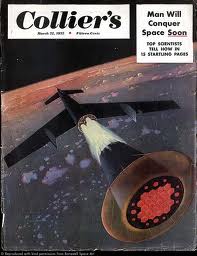
Then, in the early 1950s, Collier's magazine published a series of articles, again with many wondrous illustrations by Bonestell, elaborating how "Man Will Conquer Space Soon".

Both this book and these articles were written, and the ideas within them dreamed up, by what we might describe as a bunch of "space nerds". Foremost among them was the famed German rocket scientist Werner von Braun, who was instrumental in helping to develop modern rocketry.

But why did the ideas of a few brainy rocket scientists and space nerds, who had been laboring for decades in obscurity as members of "rocket" or "interplanetary" societies, so capture the popular imagination in the years after World War II? What exactly was it that so captivated our imaginations and excited us about leaving the safe, familiar confines of the world we had always known and venturing out into the great black infinite abyss?

Some would say that, despite all the practical justifications for space travel (whether economic, political, military, scientific, or technological), the essential reason we want to "go there", the truest and deepest reason, the real reason that we are too pragmatic and prosaic to admit... is simply because human beings have an innate urge to explore.

In this view, space exploration needs no justification outside itself... it is indeed obvious. Of course we have a drive to explore. Exploration and expansion to new territories, be they literal or figurative, are an essential and inescapable part of human history. It is part and parcel of human nature to be curious about what is "out there", beyond what we know, and to seek to discover for ourselves some part of reality as yet unknown to us.

But just because the exploration of the "final frontier" might be obvious as a desire or a goal does not mean that it is inevitable as an actual action or event. When one loses inspiration, motivation, and vision, one is not likely to achieve a long-held dream. The dream will not automatically turn itself into reality... but the dream must first exist before it can come true.

Tuesday, January 4, 2011

T + 50: 50 Years of Man in Space

The year 2011 marks two important anniversaries in the history of human spaceflight:

  • 30 years since the start of the space shuttle program, which is due to come to an end this year.
  • 50 years since the start of human spaceflight, when Soviet cosmonaut Yuri Gagarin (pictured) became the first man in space.
And of course, it is now a full decade on since the once-fabled year 2001, made mythic by Stanley Kubrick's masterful film of the same name (see my earlier post about that film).

Here's today's $64,000 question: Should 2001: A Space Odyssey be reclassified as historical fiction?

In this new occasional series, T + 50, I aim to explore the significance of human spaceflight, yesterday, today, and tomorrow. What used to be seen as the crowning pinnacle of modern civilization and the very symbol of humanity's future had become passe long before we arrived in the 21st century. Were we all just deluded by science fiction fantasies back in the 1950s and 60s? Or did we lose a grand and optimistic vision of expansion beyond the earth? Why should we care about exploring space anyway?

As a lifelong space fan, these are questions that have haunted me for most of my adult life and that I wish to investigate further in the present series. Whatever your level of interest in outer space and its exploration, I hope you enjoy taking this thought journey with me.

As the Amazing Criswell once said, "We are all interested in the future, for that is where you and I are going to spend the rest of our lives. And remember my friend, future events such as these will affect you in the future."

T minus 3... 2... 1...

Friday, December 17, 2010

Thoughts on Becoming a Parent

This week I suddenly found myself the father to a beautiful and wonderful baby girl. Even though her arrival was not exactly a surprise, in a sense it was the greatest surprise of my life. The moment she came kicking and screaming into the world, announcing her arrival loud and clear with her brand new (and already powerful) set of lungs, my wife and I looked at each other with what seemed a mixture of relief, joy, and utter amazement. What had been for 9 months a more or less abstract idea had suddenly appeared in the flesh, a living, breathing human being that we were responsible for bringing into the world. How could such things be?

When I was a younger man I felt ambivalent about the idea of having children. I think this was partly explainable by the feeling--not that I thought of it this way at the time--that my own life was a story whose outline and plot I was still trying to figure out, and that therefore I wasn't ready to launch a whole new story for someone else. In other words, why give impetus to a new human life when I was still working out the purpose and meaning of my own existence?

But now I can see that such hangups are completely beside the point. If a human life is a story--and I believe that a life is the very model of a story, the thing that stories imitate--then none of those stories are complete, or even remotely figured out, until you reach the end. Which means, of course, when you die. Every person who becomes a parent does so in the middle of things (in medias res, as in the ancient epics), while busily trying to sort out their own lives. In fact, the very act of parenthood, for those who choose it, is a monumentally important aspect of their own lives, and is one of the main factors that helps to make their lives--and their selves--what and who they are.

As a non-parent, I often heard it said that parenthood changes you, that it is impossible to comprehend the love a mother and father feel for their child without having experienced it yourself. As a new parent, I now know this from experience. Looking back, I feel that my love for my daughter grew in parallel with her growth in my wife's womb, starting as just a mustard seed upon news of her coming. Seeing the ultrasound image and learning that our child was a girl made her--and our love--one degree more real. Giving her a name made her even more real, an identifiable and unique human being. Yet she remained an enigma, an invisible and still ultimately abstract idea.

My daughter was born five days after her predicted due date, and in the final days before her birth I felt a bittersweet longing, an anxious eagerness to meet her. Upon finally--yet so suddenly--seeing her live and in person, our love for her also emerged, fully formed, as sudden and surprising as she herself.

How can I describe the love of a parent for his or her child? Like any love, it will have its ups and downs, its waves and troughs. But, as with any love, these fluctuations are only on the surface of a vast underlying sea. It has started out for me, as it undoubtedly does for most new parents, on a crest of euphoria. Strange as it may sound, the closest thing I can compare it to is the experience of being in love. Actually, it truly is being in love, just a different kind of love than is usually meant by that expression. Everything seems more meaningful, more valuable than it did before. The world glows in a radiant light that somehow had not been quite so visible until now. My daughter is to me the rarest and most precious of all earthly treasures, even though I hardly know her--even though it may seem to an outside observer that there is hardly anyone there to know. But to me she is (alongside my wife) the most interesting and important person in the world.

Where does this deep, vast sea of love come from? It is as mysterious as life itself. In fact, I would say that love, in its wide variety of forms, is the very meaning of life itself. This conviction I actually arrived at some 20 years ago, when, as a budding philosopher, I wondered what the ultimate meaning and purpose of existence was. Following the trail as far as I could, I could not get past one idea: love. This may sound strange to those of a philosophical or, certainly, a scientific cast of mind. To understand intellectually what love is--to explain it or define it--is pretty much beyond human capability. But to my mind, love, understood in the broadest possible context, was what gave ultimate meaning to everything. When you think about it, everything else we consider important--money, power, fame, success--are ultimately meaningless and empty without love. The Apostle Paul was right when he said that without love, "I am nothing." Having reached this point, I realized that love could not be justified or explained in terms of anything else. It was its own marvelous and miraculous answer: this, I decided, must be what it's all about.

My daughter, new as she is to life, has confirmed this for me like never before. What is important has its importance only in relation to what the modern philosophers call subjective consciousness and what the ancient ones called the soul. To give a definition that does not really define much of anything, one might say that love is the valuation of one consciousness or soul for another as an end in itself, rather than a means to a further end. I want to give my daughter everything that is good, whether she ever returns the favor or not. I have no doubt that as she grows up and matures, she will bring me much pride and joy and returned love, but those are not the reasons I wish to give to her. She is an end in herself--her good, her benefit, is where the buck stops. Everything I do in relation to her is ultimately measured in those terms.

Yes, I am still in the process of writing my own life story, its direction clearer than it was before, yet still a work in progress. And now I have participated in giving life to a whole new person with a whole new story. This is the way of all flesh. Plants, animals, and human beings all give rise to further generations--this thing called reproduction is nothing more nor less than life affirming itself as good. Life, too, is a mystery. Scientists can explain the physical processes of life but no one can really explain what life is. But somehow we know that, like love, life is its own answer. As someone somewhere once said, "That is all ye know, and all ye need to know."

I look forward to teaching my daughter many great and wonderful things about life and the world we live in and about herself. But I look forward even more to all the great and wonderful things that she will teach me about life and the world we live in and about myself--things that, in her own remarkable way, she has already begun to teach.